
Storm’s Breath
Finding calm moments in larger narratives, in the waters

This Saturday, a group of strangers will drive to our home and take away nearly all our earthly possessions, loading them onto a truck before driving them to a warehouse where they will be unloaded and then, as many as three weeks later, reloaded onto a semi truck along with as many other loads as they can fit that are similarly headed in the general direction of Shreveport, Louisiana.
We have metaphorical miles to go before we sleep at the end of that eventful Saturday, but we’ll get there. I hope all our stuff makes it the 1,427 actual miles—about 22 driving hours from door to door—plus whatever extra gets tacked on for that warehouse layover. In the meantime, Monique, Chloe, and I are in the midst of a trying emotional journey—one that we feel confident will lead to a rewarding new chapter.
My friend Scott Peters, who thinks a lot about stories and narratives (with all their dramatic transitions), recently posted the following quotation to his Facebook timeline:
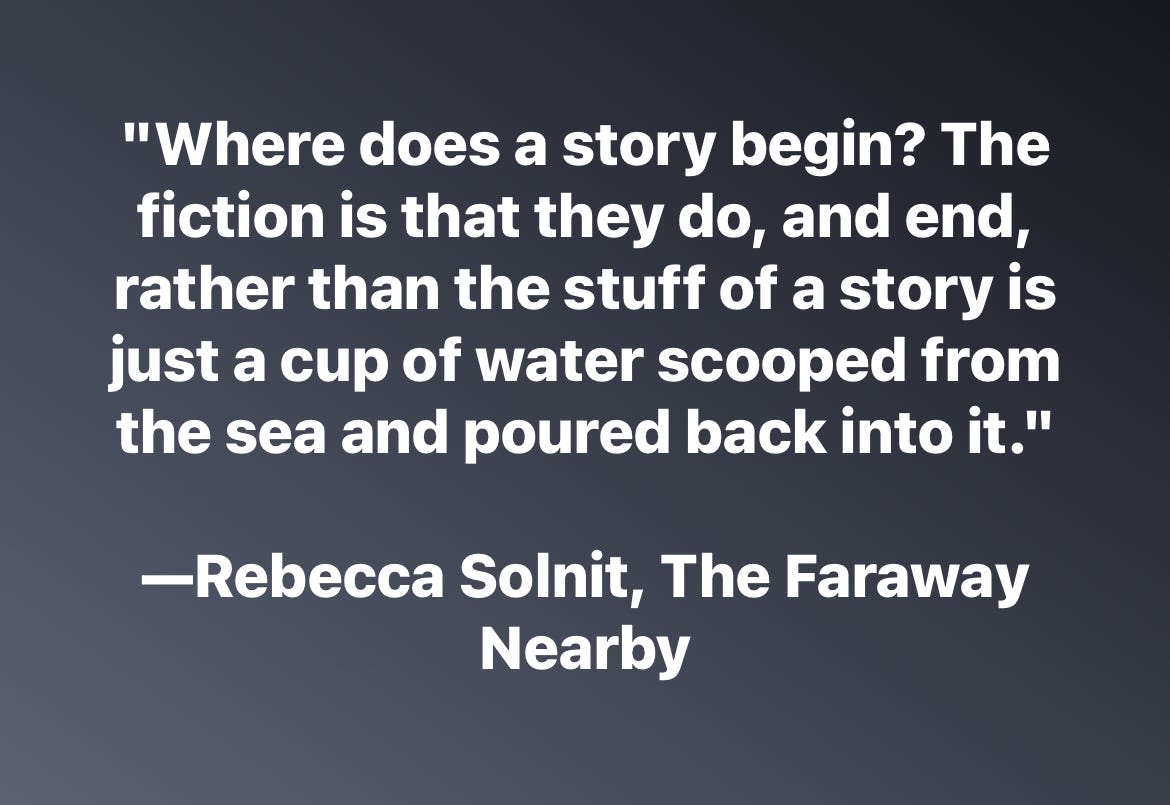
I found this a helpful and comforting way to think about a major transition. It’s easy to fall back on the clichés of “new beginnings,” of doors opening and closing, the cleanly paginated fiction of life’s “chapters.” Exactly two weeks ago now, I made my last hour-plus commute to the Climate Museum office in Hell’s Kitchen, Manhattan. The previous weekend, Monique and I made our last pilgrimage to our old haunt in Astoria, Dominie’s, to hear the jazz trio Trampleman that plays there every week (locals: consider this a recommendation!). Just last Sunday, the little neighborhood church on Tompkins Square that I’ve been attending for nearly ten years hosted a farewell coffee hour for the three of us, and that evening we had friends over to the house we’ve been renting from Monique’s folks in Hollis for the past three years (including all of Chloe’s life to date!). We have been taking account of these lasts.
But really, every transition is just another current in the messy, mixed-up sea. We can isolate stories and moments, perhaps scoop one out with a cup, but the currents are ongoing and one way or another feed into all the other currents stretching around the wet globe, more eddies and ripples and strong flowing streams than we could ever hold in our minds at one time.
During my two years working most days in Hell’s Kitchen, I made a point to walk almost every day from 9th Avenue west along 44th Street to a small park on the Hudson River during my half-hour lunch break. I’d usually pack a simple handheld meal that I could carry in a cloth shopping bag and munch on as I walked—a wrap, a piece of fruit, and a granola bar, typically—and when I got to the water I had enough time in my half hour (more or less) to lean against the railing at the end of the pier and take it in. My favorite days were often when the water surface had just enough of a sharp ripple to it that it would reflect innumerable, constantly shifting chips of sunlight back at me. Something about the flow and movement of it contrasted nicely with the steady-seeming glass and concrete of the buildings and sidewalks I had walked among moments before, a kind of happy denunciation of rigidity, planning, and comprehension. Ever moving, and yet that river had been digging out that riverbed many centuries before any of the buildings behind me had even been dreamt about, making the river much closer to something permanent and lasting.
The quotation from Solnit reminds me of the importance of occasionally stepping back from the overwhelming present to situate oneself in a larger, longer narrative. One of the first things I did after passing through the fires of my dissertation submission, before the defense had even come, was to begin rereading one of the first stories that brought me to love reading and literature—J. R. R. Tolkien’s children’s novel The Hobbit and his trilogy The Lord of the Rings. I read them first as an over-ambitious fourth and fifth grader, missing a lot in the trilogy, and then again in high school or thereabouts, and by the time I finished my dissertation I still had the old Ballantine box set I’d ordered from the Scholastic catalog decades before (which is now deep in yet another box as I bring it along to yet another state). A lot of people describe the trilogy as an epic, but, while that’s true, I think describing it in epic terms risks losing something about Tolkien’s gift for character and interiority, and of course Frodo, Sam, Merry, and Pippin are far from the traditional epic heroes. (Not to mention Gollum, without whom the quest would have failed.) it’s a story about misplaced hobbits as much as anything else. Rereading it this last time, one of my favorite passages was a discussion between Frodo and Sam (with Gollum lurking somewhere in the background) in The Return of the King, in the depths of Mordor and, increasingly, the depths of Frodo’s despair. Sam asks him if he thinks kids in the Shire, in some future time, will sing songs about them like they had sung about heroes in the distant past. Describing Frodo from the perspective of children far away and in the future brings Frodo, for the first time in weeks, to break into simple laughter, which rings brazenly against the dark cliff walls of Mordor. Sam is initially hurt, having meant it earnestly. Then Frodo responds apologetically, and says he knows he means it too, but that Sam had forgotten to mention his own role as a hero in that story. What I find interesting here is that Sam begins the discussion by going back to the past and the earlier chapters of the story they suddenly found themselves in, with their hardships and their triumphs. Situating themselves in a story larger than their own is what lightens their hearts and allows them to go on. (It comes off slightly ham-fisted and simplified in the film adaptation, I think, so I recommend going back to the original.)
This is one of many reasons that history is so important. History, and cultural stories and myths, can fortify us through the gift of these moments of calming perspective. So can bodies of water, as they stretch out perceptual horizons and reflect a world more wondrous and complex, somehow, than we have ever been able to anticipate.
The poem I’m sharing today is the third in my newly published collection, To Leave for Our Own Country, and the second that had been published elsewhere previously. It first appeared in the pages of Free State Review, in the Summer/Fall 2019 issue—just before the pandemic, around the time Monique and I got married. I first drafted it way back when I was an MFA student, though, in 2011 or 2012. It appears early in the book partly because it represents a young, adolescent frame of mind—I didn’t actually write it about any particular moment or person, but it occupies something of my late-high-school brain, in love and angst, falling for a girl and for a place both of which I feel myself being pulled away from. A storm, some dramatic change, is on the horizon, but the poem moves from a kind of awkward grappling with something I don’t want to admit is futile into a moment of calm as Lake Michigan, in its enormous incomprehensibility, asserts itself.
I’m searching for such moments of calm these days. Tonight I’m doing it here, composing on my phone’s touch screen after helping put Chloe to bed, taking the trash out, doing some dishes. It’s important, when the waters aren’t near, to have the resources of the waters to carry with you in your mind. I hope this little poem gives you a moment to catch your breath.
                          Storm’s Breath

Sand grits between our teeth, water
strands our hair into cords
that stab eyes

and I see you run
through flocks of seagulls
panting mad sweater-wet

to thud into fresh-toweled me—and I pull
you down too hard, sand blown compact,
cloud-cold. Distant booms: you snicker, we lie,

and every time the waves hiss back
a million tiny worms
peek out of holes to breathe

and then slip back. Their world,
water. And breath. And water
again. Your sweater’s rise and fall,

your shiver-laugh. Lake Michigan,
a professor once said, rises
for twenty years, and falls the same,

and no one understands
these bidecadal breaths, sweeping
homes from shorelines every forty years

when the water’s belly is biggest.
Then exhale. I wipe away a spear
of your hair but just smear sand.

When summer ends, I can’t know
what state we’ll be in, whether
we’ll remember these whitecaps

and worm fizz, the pale shocks
that stab mid-lake, coming nearer,
the sweatshirt clouds, the smell of rain.
Order To Leave for Our Own Country (Black Lawrence Press, $17.95) here: https://blacklawrencepress.com/books/to-leave-for-our-own-country/
Thank you for offering me perspective towards calm moments while currently navigating rough waters.